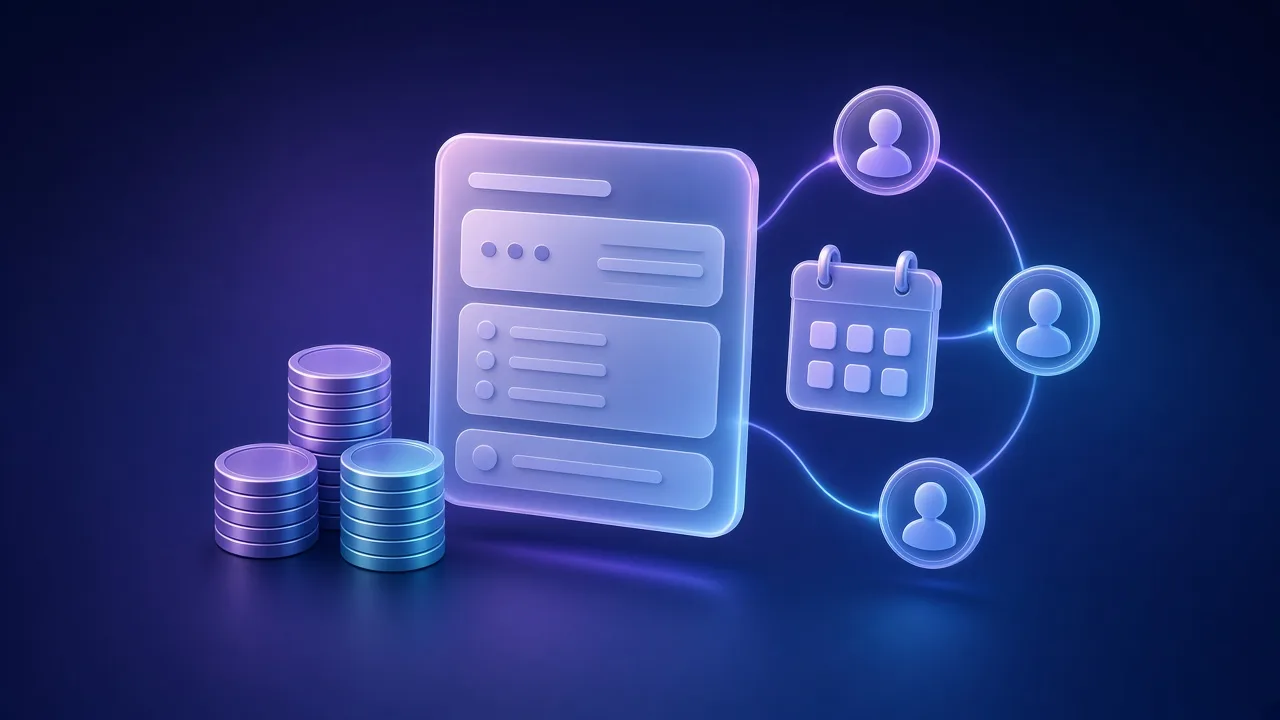
CRM stands for customer relationship management. In practice, a CRM is software that keeps every customer and prospect in one place — who they are, every conversation you have had with them, what they have bought or might buy, and what should happen next. Instead of customer knowledge living in inboxes, spreadsheets and people's heads, it lives in a shared system the whole team can use.
This guide explains what CRM software actually does day to day, the different types, what it costs, and how to tell whether your business is ready for one.
What a CRM does
- Contact management: a single record for each person and company, with phone numbers, emails, notes and history
- Activity tracking: emails, calls and meetings logged automatically from your inbox and calendar
- Pipeline management: deals shown as cards moving through stages such as qualified, proposal and won
- Tasks and reminders: the next step for every deal, so follow-ups do not slip
- Reporting: pipeline value, conversion rates, forecasts and activity by person
- Automation: assigning new leads, sending follow-up emails and updating records without manual work
Most modern CRMs also integrate with your website forms, email marketing, accounting software and support desk, so information flows between systems instead of being re-typed.
A day in the life with a CRM
A lead fills in your website contact form. The CRM creates a contact, assigns it to the right salesperson and sends them a notification. The salesperson emails from Gmail or Outlook; the CRM logs the email automatically. After a call, they move the deal to "proposal sent" and set a reminder for Friday. On Friday the reminder appears in their task list. When the deal is won, the CRM can create an invoice in your accounting software and a project in your project tool. At the weekly meeting, the team reviews the pipeline in the CRM rather than asking everyone for updates.
Types of CRM
Sales CRMs
Focused on pipelines, deals and sales activity. Pipedrive, Close and Freshsales are examples. Best for teams where salespeople drive growth.
All-in-one CRM platforms
Combine sales with marketing automation, customer service and sometimes content management on one database. HubSpot is the best-known example. Best when marketing generates most leads.
Customisable CRM platforms
Let you model unusual processes with custom objects, approvals and scripting. Zoho CRM and Salesforce lead here. Best when your process does not fit a standard pipeline.
Signs your business needs a CRM
- Leads or follow-ups are slipping through the cracks
- More than one person talks to the same customers
- You cannot quickly answer "what is in our pipeline?"
- Customer history leaves when an employee leaves
- You are copying contact details between several tools
- Your spreadsheet has become too big or too fragile to trust
How much does a CRM cost?
Several CRMs have free plans: HubSpot's is the most generous, with unlimited users, while Zoho CRM and Freshsales offer free plans for up to three users. Paid plans typically start around $9–25 per user per month. Plans with full automation, custom reporting and sequences usually cost $25–100 per user per month, and enterprise editions more. Add-ons such as calling minutes, marketing contacts and onboarding can increase the total.
For a 10-person team, a realistic budget ranges from nothing on a free plan to a few hundred dollars a month on a mid-tier plan. See our best CRM software guide for current options, or price your team in the CRM cost calculator.
CRM vs spreadsheet vs email marketing tool
A spreadsheet stores contacts but cannot log emails automatically, remind you of tasks or show a pipeline. An email marketing tool sends newsletters to lists but does not manage individual deals. A CRM combines contact records, activity history and pipeline management — and usually integrates with both spreadsheets (for import) and email marketing tools (for campaigns).
How to choose your first CRM
- Write down your sales stages and who touches each one.
- List five must-have features, such as email sync, mobile app and pipeline view.
- Shortlist two or three CRMs that fit, starting with those that have free plans or trials.
- Import a sample of real contacts and run a two-week pilot.
- Choose the one your team keeps updated without reminders.
Common CRM mistakes
- Adding dozens of fields nobody fills in
- Importing years of outdated contacts
- Not connecting email and calendar, so activity is never logged
- Buying an enterprise CRM for a five-person team
- Letting meetings run from spreadsheets after the CRM goes live
Related guides

Best CRM Software for Small Business
The best CRM software for small businesses in one shortlist — HubSpot, Zoho, Pipedrive, Salesforce, Freshsales and more compared on ease of use, automation, pricing tiers and integrations.


 Updated November 3, 2026
Best Free CRM Software
The best genuinely free CRMs for small teams — what each free plan includes, the user and feature limits that matter, and when it is time to pay.
 Updated November 3, 2026
HubSpot vs Salesforce vs Zoho vs Pipedrive
The four most-shortlisted small business CRMs compared side by side: free plans, ease of use, automation, customisation, total cost and who each one suits.
SSUpdated November 3, 2026Related comparisons
Tools mentioned
A genuinely useful free CRM that grows into a full marketing and sales platform.
Feature-rich CRM at a price point that is hard to beat, especially inside the Zoho suite.
A sales-first CRM built around the pipeline, loved by small sales teams.